User Guide for Self-Rating Anxiety Scale (SAS) and Self-Rating Depression Scale (SDS)
User Guide for Self-Rating Anxiety Scale (SAS) and Self-Rating Depression Scale (SDS)
I. Self-Rating Anxiety Scale (SAS)
Instructions
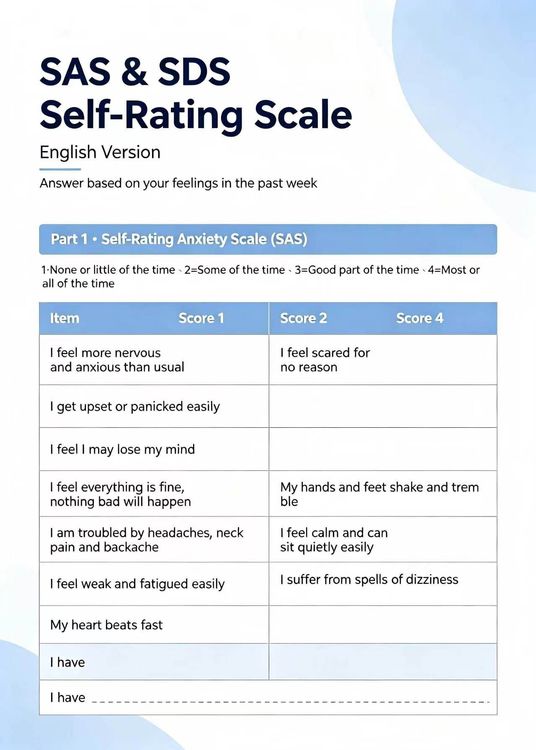
Please score each item based on your actual situation over the past week using the following criteria:
1 point: None or a little of the time
2 points: A small part of the time
3 points: A considerable part of the time
4 points: Most or all of the time
I feel more nervous and anxious than usual.
I feel afraid for no reason at all.
I get upset easily or feel panicky.
I feel like I’m falling apart and going to pieces.
*5. I feel that everything is all right and nothing bad will happen. (Reverse Scored)
My arms and legs shake and tremble.
I am bothered by headaches, neck pains, and backaches.
I feel weak and get tired easily.
*9. I feel calm and can sit still easily. (Reverse Scored)
I feel my heart beating fast.
I am bothered by dizzy spells.
I have fainting spells or feel like fainting.
*13. I can breathe in and out easily. (Reverse Scored)
I feel numbness and tingling in my fingers and toes.
I am bothered by stomachaches or indigestion.
I have to empty my bladder often.
*17. My hands and feet are usually dry and warm. (Reverse Scored)
My face feels hot and blushes.
*19. I fall asleep easily and get a good night’s rest. (Reverse Scored)
I have nightmares.
SAS Scoring Method
Forward-scored items: Assign points directly as 1, 2, 3, 4.
Reverse-scored items (marked with an asterisk *: 5, 9, 13, 17, 19): Reverse the scoring rules to 4, 3, 2, 1.
Standard Score: Sum the points of all 20 items to obtain the raw score. Multiply the raw score by 1.25 and round to the nearest integer to get the standard score.
Interpretation of Results
Based on Chinese national norms, the cutoff standard score for SAS is 50 points:
< 50 points: Normal emotional state; no significant anxiety.
50–59 points: Mild anxiety.
60–69 points: Moderate anxiety.
≥ 70 points: Severe anxiety.
Precautions
Anxiety is a feature common to various neuroses; the SAS alone cannot distinguish between different types of neuroses.
Scale scores serve only as a reference. Assessing the severity of anxiety requires combining your actual physical and emotional symptoms; diagnosis cannot rely solely on test scores.
II. Self-Rating Depression Scale (SDS)
Instructions
Please answer based on your actual state over the past week using the following scoring criteria:
1 point: None or a little of the time
2 points: A small part of the time
3 points: A considerable part of the time
4 points: Most or all of the time
I feel downhearted and blue.
*2. Morning is when I feel best. (Reverse Scored)
I have crying spells or feel like crying.
I have trouble sleeping at night.
*5. I eat as much as I used to. (Reverse Scored)
*6. I still enjoy sex as much as I used to. (Reverse Scored)
I notice that I am losing weight.
I have trouble with constipation.
My heart beats faster than usual.
I get tired for no reason.
*11. My mind is as clear as it used to be. (Reverse Scored)
*12. I find it easy to do the things I used to do. (Reverse Scored)
I feel restless and cannot keep still.
*14. I feel hopeful about the future. (Reverse Scored)
I am more irritable than usual.
*16. I find it easy to make decisions. (Reverse Scored)
*17. I feel that I am useful and needed. (Reverse Scored)
*18. My life is pretty full and interesting. (Reverse Scored)
I feel that others would be better off if I were dead.
*20. I still enjoy the things I used to enjoy. (Reverse Scored)
SDS Scoring Method
Forward-scored items: Assign points directly as 1, 2, 3, 4.
Reverse-scored items (marked with an asterisk *: 2, 5, 6, 11, 12, 14, 16, 17, 18, 20): Reverse the scoring rules to 4, 3, 2, 1.
Standard Score: Sum the points of all 20 items to obtain the raw score. Multiply the raw score by 1.25 and round to the nearest integer to get the standard score.
Interpretation of Results
The cutoff standard score for SDS is 53 points:
< 53 points: Normal emotional state; no significant depressive tendencies.
53–62 points: Mild depression.
63–72 points: Moderate depression.
≥ 73 points: Severe depression.
Important Notice
This scale is intended solely for preliminary self-screening of emotional states and cannot replace a professional diagnosis by a psychiatrist or mental health doctor at a hospital. If you experience persistent low mood, anxiety, or distress that impacts your daily life, please seek assessment at a legitimate hospital in a timely manner.